
Search by cell or niche
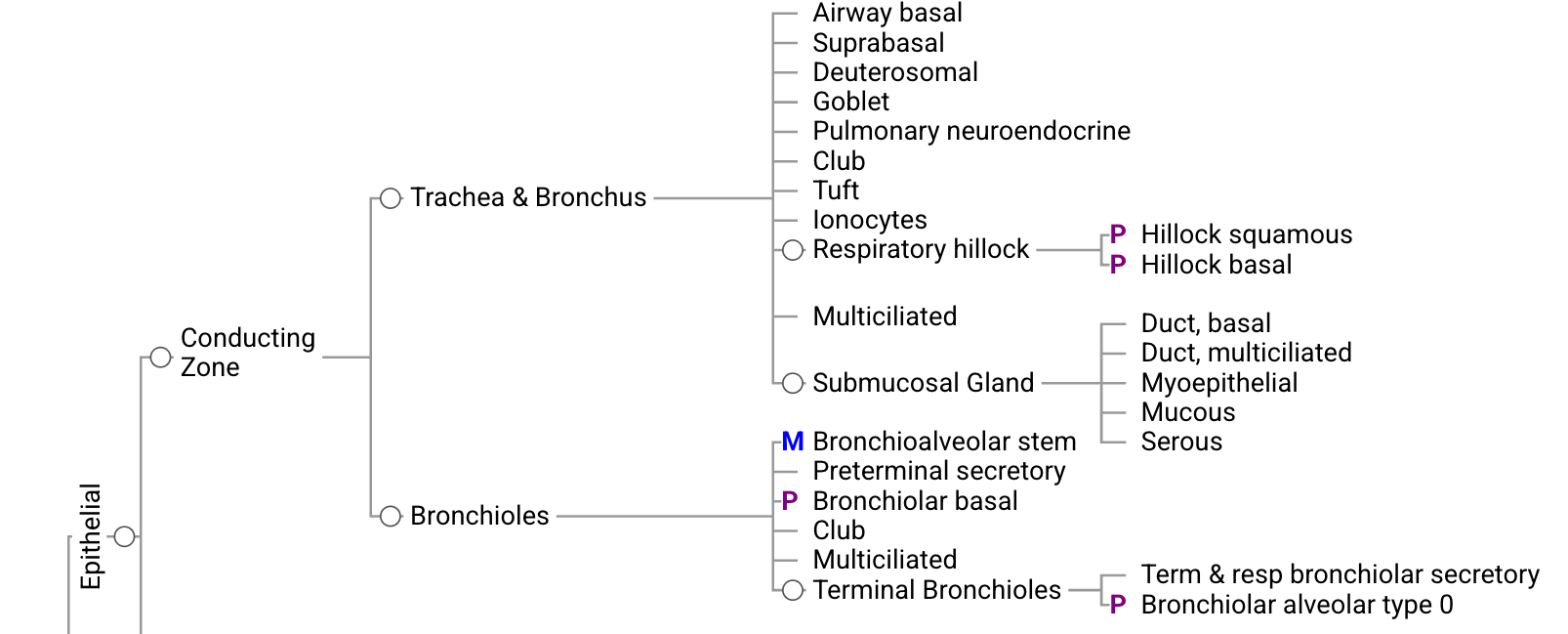
Two resources describe lung cells, and they answer different questions. CellCards describes what a cell type is: its markers, its lineage and its function. The Niche Explorer describes where those cells sit: the tissue structures they build, and how those structures change in disease. Both are indexed by the same cell-type names, so a cell type can be followed from one to the other.
CellCards Explorer
Explore expert curated cell types and function
Expert-curated records for each cell type of the human lung: canonical markers, developmental origin, function, disease associations and ontology identifiers, organised by anatomical compartment. Use it to establish what a cell type is and how it has been defined in the literature.
Open CellCards →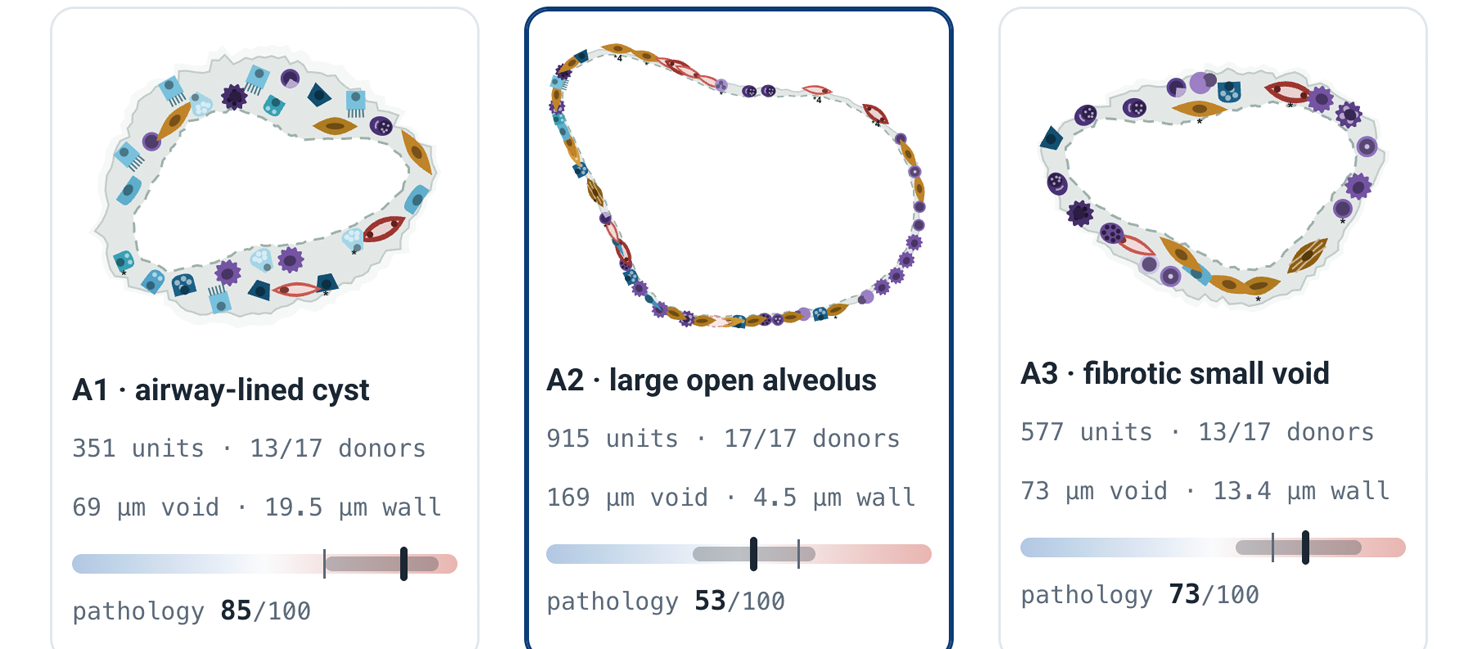
Niche Explorer
Explore lung tissue niches in health and disease
Lung tissue regions from image-based spatial transcriptomics, each drawn in the grammar its anatomy requires: the air sac as a lined ring, the fibrotic niche as a solid focus. An exploratory mixture model groups each family of regions without labels; each group reports its cell composition, its radial organisation, its donors, its concordance with the published niche labels, and the genes that separate it. Use it to explore where a cell type sits within the tissue, and how that differs in disease.
Open the Niche Explorer →The Niche Explorer is under review and is not yet linked from the site navigation. It covers all 45 samples of GSE250346, from 35 donors across 5 tissue arrays. Its tissue foci use the pathologist's annotations. An exploratory mixture model groups regions using cell-type abundance by depth, neighboring cell types, region cell count and spatial span. The resulting groups summarize this dataset; they are not established biological archetypes or independently validated disease categories.